-
Lithium-Ion Battery Recycling Market Trends Shaping the Circular Battery Economy
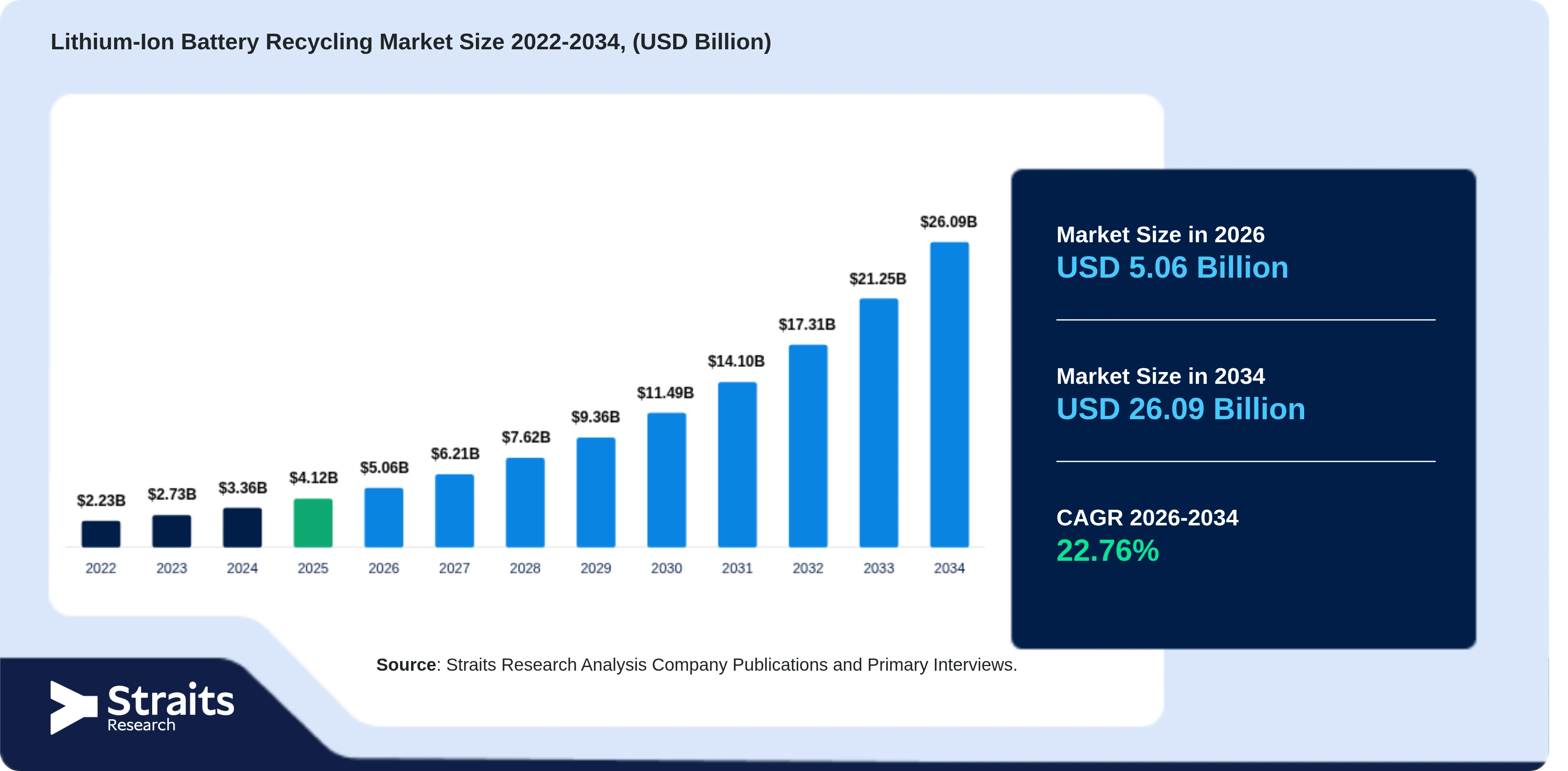
The global lithium-ion battery recycling market was valued at USD 4.12 billion in 2025 and is projected to grow from USD 5.06 billion in 2026 to USD 26.09 billion by 2034, registering a CAGR of 22.76% during the forecast period (2026–2034). Europe dominated the market in 2025, accounting for 36.8% of global revenue, while Asia Pacific is expected to be the fastest-growing region, with a projected CAGR of 21.36%.
Market Size (2025): USD 4.12 billion
Market Size (2026): USD 5.06 billion
CAGR (Forecast Period): 22.76% from 2026 to 2034
Forecast Year: 2034
Projected Market Size (2034): USD 26.09 billion
Dominant Region: Europe—36.8% market share in 2025
Fastest Growing Region: Asia Pacific – 21.36% CAGR
Market Overview
Lithium-ion battery recycling involves collecting, sorting, dismantling, and processing used batteries to recover valuable materials such as lithium, nickel, cobalt, copper, and manganese. These recovered materials can re-enter battery and other industrial supply chains, reducing waste and dependence on newly extracted resources. Electric vehicles, consumer electronics, power tools, and energy storage systems provide important sources of spent batteries and manufacturing scrap.Growth Drivers
Electric vehicle manufacturing and battery production create a growing need for reliable supplies of lithium, nickel, cobalt, and other battery materials. Recycling provides a secondary source of these inputs, allowing battery producers to diversify procurement and reduce dependence on newly mined resources. The International Energy Agency’s 2025 critical-minerals analysis highlights recycling as an important route for strengthening mineral supply chains, supporting investment in collection systems and recovery facilities.Market Challenges
High capital requirements for collection, battery dismantling, pretreatment, and material recovery can delay facility development and make commercial scaling difficult. Differences in battery chemistry, cell design, and material composition also require specialized sorting and processing methods, complicating operations that handle mixed battery streams. In addition, lithium iron phosphate batteries generally contain fewer high-value metals than nickel-rich chemistries, which can affect recycling economics and the revenue available from recovered materials.Market Opportunities
Battery manufacturers and recyclers can establish closed-loop recovery agreements that turn production scrap into reusable materials and create long-term processing contracts. Specialized recyclers can also develop services for electric vehicle fleets, battery producers, and energy-storage operators, covering collection, safe handling, material recovery, and end-of-life management. Investment in direct cathode recycling and chemistry-specific recovery technologies offers another revenue avenue by preserving more of the value contained in battery materials.Segment Analysis
By battery chemistry, the lithium-nickel-manganese-cobalt segment accounted for the largest share of the lithium-ion battery recycling market, at 32.7% in 2025. Its position reflects the use of nickel-manganese-cobalt batteries in electric vehicles and other applications requiring high energy density, along with the recovery value of their constituent metals.By source, the electric vehicle segment is projected to grow at a CAGR of 22.14% during 2026–2034, driven by the expansion of electric mobility and the need to recover materials from batteries at the end of their service life. Manufacturing scrap also remains an important feedstock for recycling facilities while larger volumes of retired vehicle batteries gradually enter the waste stream.
By the recycling process, the hydrometallurgical segment accounted for the largest share, representing 46.9% in 2025. Its ability to extract selected metals from processed battery material supports its application in recovering lithium, nickel, cobalt, and other valuable constituents.
By end-user, the automotive segment is projected to grow at a CAGR of 21.84% during 2026–2034, owing to the expanding use of rechargeable batteries in electric vehicles and the need to manage end-of-life automotive battery packs.
By battery component, the active-material segment held the largest share, accounting for 68.5% in 2025. Its position is supported by the economic value of recoverable battery metals and their potential reuse in battery-material production.
Regional Analysis
The Europe Lithium-Ion Battery Recycling Market accounted for the largest regional share of 36.8% in 2025. Battery-recycling infrastructure, circular-economy initiatives, and regulatory requirements for material recovery support the region’s position. Under the EU Batteries Regulation, lithium-based battery recycling must meet a minimum recycling efficiency of 65% by the end of 2025, while material-recovery targets for lithium and other metals become more stringent over time.The Asia Pacific Lithium-Ion Battery Recycling Market is expected to grow at a CAGR of 21.36% during the forecast period, showcasing the fastest-growing regional market. The region’s battery manufacturing base, electric vehicle production, and established role in battery-material processing provide opportunities for recycling companies. China, Japan, South Korea, and India are important markets to watch as battery deployment, collection infrastructure, and domestic resource-recovery initiatives evolve.
North America also represents a significant market, supported by investment in battery supply chains and technology development. Europe’s regulatory framework and Asia Pacific’s manufacturing ecosystem will continue to shape competitive conditions, while growth in Latin America and the Middle East and Africa will depend partly on battery deployment, collection networks, processing investment, and access to downstream material buyers.
Competitive Landscape
The Lithium-Ion Battery Recycling Market features battery recyclers, metal-recovery specialists, battery manufacturers, and technology developers competing on recovery rates, processing costs, feedstock access, plant capacity, and the quality of recovered materials. Established participants benefit from industrial processing expertise and downstream partnerships, while technology-focused companies pursue improved separation methods, direct recycling, and more efficient recovery from different battery chemistries. Regulatory compliance and dependable access to battery waste remain important factors in building commercially viable operations.Key companies include:
Ganfeng Lithium Co., Ltd.
American Battery Technology Company
Li-Cycle Corp.
Fortum Corporation
Umicore
Recent Developments
In July 2026, the U.S. Department of Energy announced eight winning teams in the Lithium-Ion Battery Recycling Prize: Breakthrough Contest. Each team received USD 200,000 and advanced to Phase IV of the competition, which supports the development of technologies intended to strengthen battery recycling and critical-material supply chains.In 2026, the European Commission assessed whether recycling-efficiency and material-recovery targets under the EU Batteries Regulation should be revised in light of changes in battery chemistry, the availability of recovered metals, and technical progress. The review highlights the importance of improving recovery processes as battery compositions evolve and the economics of recycling change.
Click to Read the Complete Insights & Report: https://straitsresearch.com/report/lithium-ion-battery-recycling-market
Future Outlook
The lithium-ion battery recycling market is projected to expand substantially through 2034 as electric vehicle deployment, battery manufacturing, and energy storage create additional opportunities for material recovery. Europe’s regulatory framework supports recycling investment, while Asia Pacific’s battery manufacturing ecosystem provides a strong foundation for market expansion. Future competitiveness will depend on securing sufficient feedstock, improving recovery efficiency, adapting to changing battery chemistries, and developing commercially sustainable routes for reusing recovered materials.About Straits Research
Straits Research is a market research and intelligence firm providing industry analysis, market sizing, forecasts, and strategic insights across multiple sectors. Its research helps businesses and decision-makers understand market dynamics, evaluate competitive positioning, and identify potential growth opportunities.![Profile Photo]() liked this