-
Recessed Lighting Market Size to Reach USD 104.79 Billion by 2034
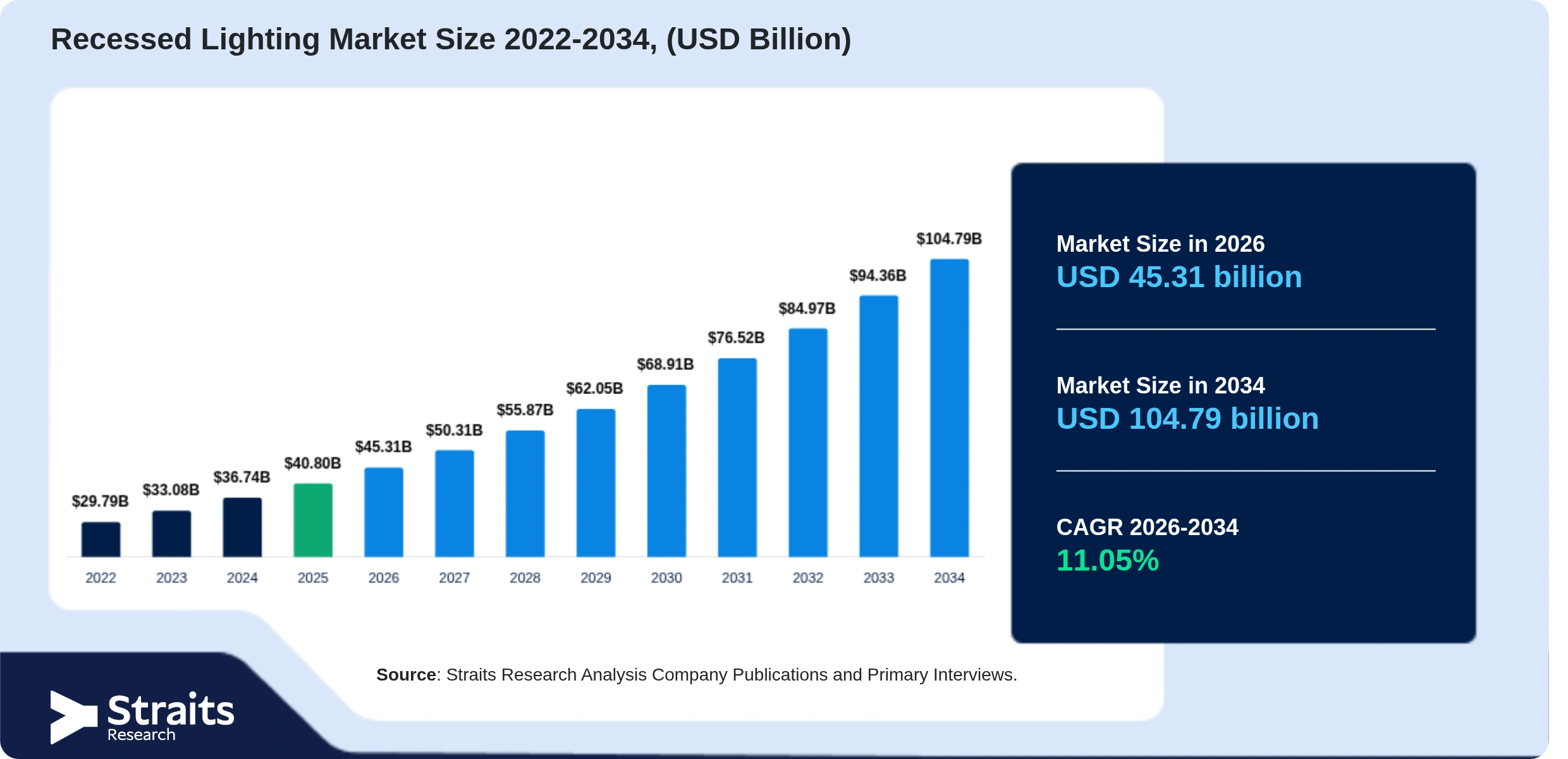
According to Straits Research, the recessed lighting market size was valued at USD 40.8 billion in 2025 and is projected to increase from USD 45.31 billion in 2026 to USD 104.79 billion by 2034, registering a CAGR of 11.05% during the forecast period (2026–2034). North America accounted for 34.7% of the market share in 2025, supported by established construction activity, extensive home renovation projects, and strong adoption of energy-efficient lighting technologies.Recessed lighting refers to lighting fixtures installed within ceilings or walls, with the light source positioned inside a recessed housing rather than extending outward from the surface. Commonly known as downlights or can lights, these fixtures provide focused, ambient, and accent illumination across residential, commercial, and industrial spaces. Available in LED, compact fluorescent, incandescent, and halogen configurations, recessed lighting systems support modern architectural designs by maintaining clean ceiling lines and reducing visual clutter. Their application in kitchens, offices, retail stores, hotels, and institutional buildings makes them an important component of contemporary interior and architectural lighting.
Recessed Lighting Market Drivers
Construction and Renovation Activities Strengthen Lighting Installation RequirementsResidential and commercial construction projects create substantial opportunities for recessed lighting installations. Architects and interior designers frequently incorporate these fixtures into modern building layouts because they provide uniform illumination while maintaining a minimalist appearance. Home renovation and remodeling activities also encourage property owners to replace conventional ceiling fixtures with recessed lighting systems. New residential developments, commercial offices, hospitality facilities, and retail spaces require lighting solutions that combine functionality with architectural appeal, supporting product adoption across building projects.
Energy Efficiency Requirements Encourage LED Recessed Lighting Adoption
Energy conservation initiatives and building efficiency standards are encouraging the use of lighting systems with lower electricity consumption and longer operating lives. LED recessed lights offer advantages over conventional incandescent and halogen alternatives through improved energy efficiency, reduced heat generation, and lower maintenance requirements. Commercial building operators and homeowners increasingly consider operating costs and lighting performance when selecting fixtures. Government incentives and energy-efficiency programs also encourage the replacement of conventional lighting with LED-based recessed systems.
Recessed Lighting Market Trends
Integration of Smart Lighting and Adjustable Illumination FeaturesSmart lighting technology is changing the functionality of recessed lighting systems. Manufacturers are introducing fixtures with wireless connectivity, smartphone controls, voice-assistant compatibility, dimming functions, and adjustable color temperatures. These features allow users to modify lighting intensity and ambiance according to different activities and room requirements. Integration with home automation platforms also enables scheduled operation and centralized lighting management, making smart recessed fixtures suitable for connected residential and commercial environments.
Advancements in LED Design and Architectural Lighting Performance
Product development increasingly focuses on improving LED efficiency, visual comfort, beam control, and installation flexibility. Deep-regressed downlights, adjustable recessed fixtures, and modular lighting systems allow designers to direct illumination while reducing glare. Manufacturers are also developing compact and canless LED products that simplify installation in different ceiling configurations. These developments support the use of recessed lighting in contemporary interiors where lighting quality, aesthetic consistency, and installation convenience are important considerations.
Recessed Lighting Market Segmentation Analysis
The recessed lighting market is segmented by type, applications, and distribution channel.By Type
LED Recessed Lighting
Compact Fluorescent Recessed Lighting (CFL)
Incandescent Bulbs Recessed Lighting
Halogen Recessed Lighting
Others
LED recessed lighting represents an important product category because of its energy efficiency, long operating life, and suitability for modern residential and commercial installations. These fixtures provide different color temperatures, brightness levels, and beam angles, allowing users to select products according to room size and lighting requirements. Their compatibility with dimming systems and smart controls further strengthens their position in contemporary lighting designs.
Incandescent bulb recessed lighting has traditionally been used for its warm illumination and relatively low initial purchase cost. However, its higher energy consumption, heat generation, and shorter operating life make it less suitable for energy-conscious installations. Energy-efficiency regulations and the availability of advanced LED alternatives have encouraged users to consider more efficient replacement products.
By Applications
Residential
Commercial
Industrial
Residential applications represent a significant category in the recessed lighting market, supported by home renovation activities and the preference for modern interior designs. Homeowners use recessed fixtures in kitchens, living rooms, bedrooms, hallways, and bathrooms to achieve consistent illumination without adding bulky ceiling fixtures. LED-based products are particularly suitable for residential installations because of their energy-saving characteristics and availability in different lighting configurations. Smart home adoption and interest in customized indoor lighting also support product use in residential properties.
Commercial applications include offices, retail outlets, hotels, restaurants, and institutional buildings where recessed lighting provides functional and architectural illumination. Industrial facilities use specialized recessed fixtures in selected indoor workspaces and operational areas that require appropriate lighting arrangements.
By Distribution Channel
Offline
Online
Online distribution is gaining traction because digital platforms provide access to a wide range of recessed lighting products, technical specifications, and customer reviews. Consumers, contractors, and businesses can compare fixture designs, brightness levels, dimensions, and prices before making purchasing decisions. E-commerce platforms also improve access to specialized lighting products that may not be readily available through local retailers. Manufacturers and distributors are strengthening their digital sales channels to reach residential buyers, contractors, and commercial customers.
Offline distribution remains important because lighting showrooms, electrical retailers, and specialty stores allow buyers to examine product designs and assess lighting characteristics before purchasing. Contractors and commercial project buyers also use established distributor networks to source products and obtain technical assistance.
Recessed Lighting Market Regional Insights
North America Dominates the MarketNorth America accounted for 34.7% of the recessed lighting market share in 2025. The region benefits from established construction activity, extensive residential remodeling, and consumer awareness of energy-efficient lighting technologies. The United States contributes significantly through residential renovation projects, commercial building development, and the adoption of modern interior lighting solutions. Canada also supports regional activity through sustainable building practices, energy conservation initiatives, and the use of LED lighting in residential and commercial properties.
Europe Emerges as the Fastest-Growing Region
Europe is expected to register the fastest growth during the forecast period. The region’s emphasis on energy efficiency, sustainable construction, and smart building development supports the adoption of advanced recessed lighting systems. Germany represents an important country-level market through its construction industry, manufacturing capabilities, and focus on energy-efficient building technologies. The United Kingdom also contributes through home renovation activities, smart home adoption, and regulations encouraging improved energy performance in buildings. These factors create opportunities for manufacturers offering LED downlights, adjustable fixtures, and connected lighting solutions.
For Detailed Insights, Visit
https://straitsresearch.com/report/recessed-lighting-marketRecessed Lighting Market Key Players Analysis
The recessed lighting market includes established lighting manufacturers, architectural lighting specialists, and providers of advanced LED solutions. Competition is shaped by energy efficiency, illumination quality, product durability, design flexibility, smart connectivity, and distribution capabilities. Established companies strengthen their portfolios through LED technology, adjustable lighting systems, and application-specific fixtures, while specialized manufacturers focus on architectural performance and customized lighting solutions. Key players identified in the report include:Philips Lighting (Netherlands)
General Electric (U.S.)
Cree Inc. (U.S.)
Acuity Brands Lighting, Inc. (U.S.)
Osram GmbH (Germany)
Opportunities in the Recessed Lighting Market
Development of Smart and Tunable LED Recessed LightingSmart and tunable lighting technologies offer manufacturers opportunities to introduce differentiated recessed fixtures for connected residential and commercial buildings. Companies can develop products with adjustable color temperatures, programmable brightness settings, wireless controls, and compatibility with home automation systems. Investments in sensor integration and advanced lighting management software can also support customized solutions for offices, hospitality facilities, and modern residential interiors.
Expansion of Modular and Retrofit Lighting Solutions
Modular and retrofit recessed lighting systems provide opportunities for manufacturers serving renovation projects and existing buildings. Companies can develop compact LED modules, adjustable downlights, and installation-friendly fixtures designed to fit different ceiling configurations. Partnerships with contractors, electrical distributors, and architectural design firms can strengthen product reach across residential and commercial projects. Manufacturers can also differentiate their portfolios through flexible beam control, improved glare management, and simplified installation systems.
Final Thoughts
The recessed lighting market is shaped by construction and renovation activities, energy-efficiency requirements, and the adoption of modern architectural lighting solutions. LED recessed lighting is an important product category, while residential installations represent a significant application area. Online distribution is gaining relevance as consumers and businesses increasingly compare lighting products through digital platforms. North America maintains the dominant regional position, whereas Europe offers strong growth potential through sustainable construction and smart building initiatives. Manufacturers focusing on connected lighting, efficient LED technology, modular designs, and retrofit solutions are positioned to strengthen their competitive presence during the forecast period.About Us
Straits Research is a market research and intelligence organization that provides industry insights, market sizing, competitive analysis, and strategic research across various industries. The company supports businesses, investors, and decision-makers with data-driven information to help identify market opportunities, understand industry dynamics, and make informed business decisions.![Profile Photo]() liked this